

Files
Download Full Text (1.2 MB)
Description
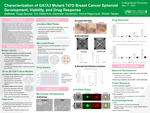
Breast cancer is the most commonly diagnosed cancer in women, with luminal subtypes representing the majority of cases. Among these, 10–15% contain mutations in the transcription factor GATA3, including the P409fs frameshift mutation that produces an extended, dysregulated protein. Because traditional 2D culture systems fail to replicate the structural and biochemical complexity of in‑vivo tumors, this study employed 3D spheroid models to investigate how the P409fs mutation influences T47D breast cancer cell morphology, growth, and drug response. Control and P409fs T47D cells were aggregated using U‑bottom plates and microwell platforms to generate spheroids of defined size. Spheroid circularity, diameter, and proliferation were monitored over seven days, and drug sensitivity was assessed using paclitaxel (0.5 µM) and abemaciclib (0.5 µM). Both genotypes successfully formed spheroids; however, P409fs spheroids exhibited less uniform borders and reduced circularity compared to controls. Despite these morphological differences, proliferation rates were similar between groups. Drug assays showed comparable decreases in viability following paclitaxel and abemaciclib treatment, with no major divergence in short‑term drug sensitivity. These findings suggest that while the P409fs mutation alters spheroid architecture, it does not substantially impact early growth or drug response in 3D culture, providing a foundation for extended viability and organoid‑based studies.
Publication Date
6-1-2026
Document Type
Poster
City
Grand Forks, ND
Keywords
breast cancer, spheroid, 3D-model, cancer mutant, cancer viabilty
Recommended Citation
Bonnet, Paige, "Characterization of GATA3 Mutant T47D Breast Cancer Spheroid Development, Viability, and Drug Response" (2026). Arts & Sciences Undergraduate Showcase. 35.
https://commons.und.edu/as-showcase/35
Comments
Presented at the Spring 2026 Arts & Sciences UNDergraduate Showcase in Grand Forks, ND, May 7, 2026.