

Project Team
Lauren Huso, Kiera Musil, Dylan Niemi, Dr. Joonghwa Lee
Preview
Creation Date
9-17-2025
Description
Türkiye | Grand Forks, ND
Nuri Oncel
Naturalized in 2017
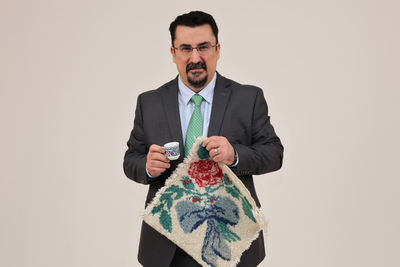
Photographic portrait documenting Nuri Oncel’s participation in the Constitution Day Project.
Small Rug - This holds one of my earliest memories of my grandmother’s home, a lake house tucked away in a quiet town, much like the ones we have in North Dakota and Minnesota. We spent countless summers there, the lake’s gentle waves a backdrop to the simple joys of those days. Rugs, however, carry more than just sentimental value in Turkish culture – they are woven with meaning. Every flower, every shape etched into the fabric tells a story. In fact, the periodic shapes in these designs are a striking example of mathematics woven into everyday life. The repetition of these motifs can be seen as a form of symmetry: translational symmetry (where the pattern shifts by a set distance), rotational symmetry (where the pattern repeats after a turn), and reflectional symmetry (where the pattern mirrors itself along a line or axis). As a physicist working with crystals, this symmetry resonates deeply with me. It’s like finding a little piece of the mathematical world embedded in the fabric of daily life – golden in its precision and beauty.
Turkish Coffee Cup - Coffee was introduced to the Ottoman Empire in the early 16th century. The first coffeehouse, or kahvehane in Turkish, opened in Istanbul in 1554. These establishments became important social hubs, where people gathered to discuss politics, literature, and daily life. Coffeehouses played a crucial role in the social and cultural life of the Ottoman Empire, much like modern cafés today. The coffee cup I brought had tulip figures on it. The name “tulip” itself comes from the Turkish word “tülbent,” meaning “turban,” due to the flower’s resemblance to the shape of the Ottoman turban. During the “Tulip Era” (Lâle Devri), tulips became a prominent motif in Ottoman art, literature, and ceramics.
Recommended Citation
Huso, Lauren, Kiera Musil, Dylan Niemi, & Joonghwa Lee. “Nuri Oncel” (2025). UND Constitution Day Project Photographs. 23. https://commons.und.edu/constitution-day-photos/23
Comments
If you would like to cite or use this project, please contact Dr. Joonghwa Lee at [email protected] in advance.