

ALL: Master Collection List
Nationality
American
Preview
Date of Work
2022
Medium
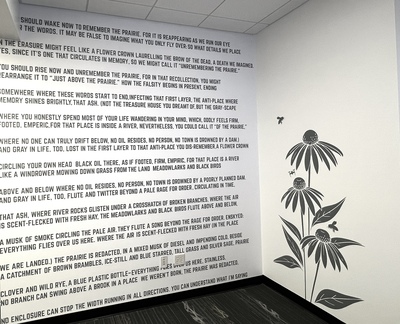
Poetry, installed in vinyl, with vinyl silhouette images of coneflowers, bees, and drones
Collection/Provenance
Research & Economic Development Collection
Status
Displayed
Location
Division of Research & Economic Development
Artist Bio
Casey Fuller is an artist, poet, and holds an MFA in creative writing. Originally from Olympia, Washington, Fuller is currently a Doctoral Candidate in the English Department at The University of North Dakota. Fuller describes himself as an artist who also works in the medium of creative writing. His work showcases the intersection of the visual with the written word.
Additional Information
Prairie Surrealism:
Casey Fuller's The Prairie introduces visitors to Prairie Surrealism by revealing the prairie as both physical landscape and imaginative terrain. Paired with native coneflowers, bees, and a miniature drone, the installation bridges ecology, technology, and poetry, demonstrating that research and creativity are complementary ways of understanding place.
Like UND's research enterprise, the work invites us to look beyond what is immediately visible. Whether viewed from the ground among pollinators or from above through emerging technologies, the prairie becomes a site of inquiry where memory, observation, and discovery converge.
The inclusion of the drone in the installation serves as a metaphor for evolving perspective. It doesn't replace the bees or the flowers; it works alongside them. One represents millions of years of natural intelligence, the other human ingenuity. Together, alongside Fuller's reflective and cautionary poem, they embody UND's unique position at the intersection of environmental stewardship, aerospace innovation, and prairie identity.
Full text of poem:
The Prairie (Winner of the 2023 Thomas McGrath Award in Poetry)
You should wake now to remember the prairie. For it is reappearing as we run our eyes
over the words. It may be false to imagine what you only fly over: so what details we place
in the erasure might feel like a flower crown laurelling the brow of the dead. A death we imagined,
yes, since it’s one that circulates in memory, so we might call it “un-remembering the prairie.”
You should rise now and un-remember the prairie, for, in that recollection, you might
rearrange it to “just above the prairie.” See how the falsity begins in present, ending
somewhere where these words start to end, infecting that first layer, the anti-place where
memory shines brightly, that ash. (Not the treasure house you dreamt of, but the gray-scape
where you honestly spend most of your life wandering in your mind, which, oddly feels firm,
footed, empiric, for that place is inside a river, nevertheless, you could call it “of the prairie,”
where no one can truly drift below, no oil resides, no person, no town is drowned by a dam.)
And gray in life, too, lost in the first layer, to that anti-place you dis-remember, a flower crown
circling your own head, black oil there, as if footed, firm, empiric, for that place is a river,
like a windrower mowing down grass from the land. Meadowlarks and blackbirds flute
above and below where no oil resides, no person, no town is drowned by a poorly planned dam.
And gray in life, too, flute and twitter beyond a pale rage for order, circulating in time,
that ash, where river rocks glisten under a crosshatch of broken branches, where the air
is scent-flecked with fresh hay, the meadowlarks and black birds flute above and below,
a musk of smoke circling the pale air. They flute a song beyond the rage for order, enskyed:
everything flies over us here. Where the air is scent-fleck with fresh hay (in the place
we are landed) the prairie is redacted, in a mixed musk of diesel and impending cold, beside
a catchment of brown brambles, ice-still and blue starred, tall grass and silver sage, prairie
clover and wild rye, a blue plastic bottle—everything flies over us here, stainless.
No branch can swing above a brook in a place we weren’t born, the prairie was redacted,
no enclosure can stop the width running in all directions. You can understand what I’m saying
when I tell you an endlessness runs all ways at once—the way tallgrass and silver sage, prairie
clover and wild rye, a plastic bag from a superstore—is not a kind of limit. Sometimes I imagine us
lying down looking up at the planes flying above us (...tallgrass and silver sage, no branch above
the brook in the place we weren’t raised) in a space that is nothing like the prairie. But certainly
we can imagine a truer place, where the real ground is covered (you can understand
what I’m telling you when I say endlessness runs all directions at once) by needlegrass,
by common cattail—nothing acts as a kind of limit. And slow below the leaves of grass,
bleached in the alkaline salt shallows, a system of roots. But certainly we can see the other place,
also, where the ground is covered in steaming windrows of upturned land, so grave-like,
so life-giving, also, by needlegrass, by common cattail. We were once found in the prairie,
so circled in, and yet so grave-like and upturned, too, but the truth is, it is founded in us now.
Rights
Copyright retained by artist. May not be reproduced without permission.