

Nationality
American, Arikara Nation
Preview
Date of Work
2026
Medium
Acrylic on canvas
Collection/Provenance
Contemporary Indigenous Art Collection
Status
Displayed
Location
Division of Research & Economic Development
Artist Bio
Jennifer (J.) White is an artist of the Arikara Nation, born on the prairies of Yankton, SD. She is the owner/curator of Post Pilgrim Gallery in Sioux Falls, SD. Founded in 2015, Post Pilgrim is White’s contribution to the beautiful culture of the Great Plains Indian. A self-taught painter, White shares her culture through the lens of an urban Indian. White’s work has been exhibited in Paris, Venice, and at the Smithsonian. Each year she shows her work in California, New Mexico, Indiana, Montana, and Illinois—to name a few. In her 15-year career as a professional artist, White has received numerous awards for her work as a painter and culture bearer for her Native community. White’s culture continues to influence her paintings, which are both representational and abstract. Her humor and political conscience are palpable in her work. White also uses sculpture to explore an array of subject matter, allowing her to visualize her paintings in 3-D.
White continues to work tirelessly for her beloved state of South Dakota, paying tribute to the friends and family who support her work unconditionally. J. White is honored to be a voice and vessel for the humanities.
Additional Information
PRAIRIE SURREALISM:
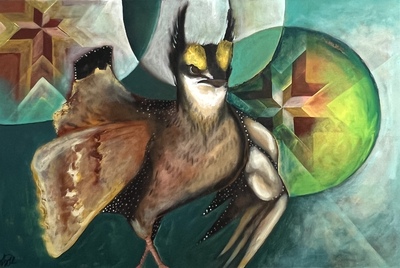
A prairie chicken fills the canvas, its golden eye combs blazing and its gaze fixed directly on the viewer. J. White abstracts its plumage into sculpted, almost architectural forms. Behind the bird, star quilt patterns and a glowing green orb drift across a field of teal, and a scatter of white dots shimmers through the dark areas like stars or beadwork. Familiar and strange at once, the bird seems less observed than encountered, rendered with the confidence and wry humor.
The star that frame the bird are, across many Plains nations, found on star quilts made to honor, given to mark important moments, and to show respect. White extends that honor to a bird once abundant across the grasslands, whose spring dances on its booming grounds were among the prairie’s great spectacles. Today prairie chickens survive in far smaller numbers, their fate tied to the native grasslands that remain and the work of those stewarding the native prairies of North Dakota.
Condition
Excellent