

Nationality
American, Cherokee Nation
Preview
Date of Work
2019
Medium
Gouache on paper
Collection/Provenance
Contemporary Indigenous Art Collection
Status
Displayed
Location
Division of Research & Economic Development
Artist Bio
Hattie Lee Mendoza is a member of the Cherokee Nation. Mendoza was born in Fowler, Kansas. She now resides and works in Peoria, Illinois. In 2012 she earned her BA in Graphic Design from Tabor College. In 2021 she completed her MFA at Bradley University in Peoria, IL.
Mendoza looks at her process as, "a personal narrative of the Native American Diaspora."
From the artists website:
"I desire my art to open conversations and be a starting point to discussing tribes, Native Americans past and present, and the many nuances of being descended from Native cultures in a world growing increasingly diverse in numerous ways with every generation. For myself, this also includes my time in Southeast Asia and friendships I’ve made globally.
Cultivating and presenting a joy of cultural differences, influences, and histories allows hope to exist for where we might go in regards to tribes, countries, and personal communities in the future."
https://hattieleeart.com/about
Additional Information
PRAIRIE SURREALISM:
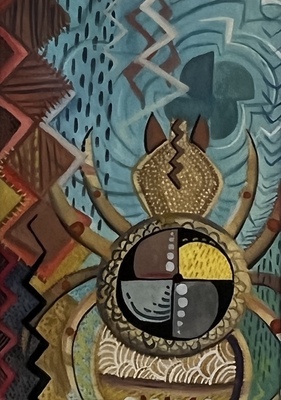
In a Cherokee story of how the world first received fire, lightning struck a sycamore on a distant island, and one by one the animals tried to bring the fire back. The raven was scorched black, the owls were left with smoke-ringed eyes, and the snakes returned charred. Finally, the small Water Spider crossed the water, wove a bowl from her own thread, carried it on her back, and brought home a single glowing coal. Hattie Lee Mendoza renders her mid-journey, her body patterned like woven fiber and the quartered bowl on her back. Lightning zigzags at the edges, and the blue water ripples around her in concentric rings. Myth, pattern, and creature merge into one vivid emblem, with the story’s dream logic made visible.
Mendoza's painting reminds us that a small creature succeeded by inventing a tool to carry what could not be held. Questions about fire, and the energy it represents, remain urgent today. UND researchers have spent decades developing ways to produce, store, and use energy responsibly, much of it rooted in the resources and needs of the Northern Plains.
Condition
Excellent