-
Developing and Sustaining Indigenous Nursing Leadership: The HEAL Southwest Leadership Cohort
Cristina Rivera Carpenter and Adriann Begay
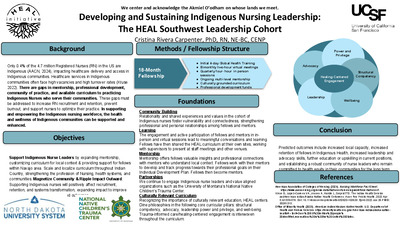
While Indigenous Peoples represent 2.9% of the total United States (US) population (Office of Minority Health, 2025), only 0.4% of the 4.7 million Registered Nurses (RN) in the US are Indigenous (AACN, 2024). This disparity in nursing representation impacts healthcare delivery and access in Indigenous communities. Healthcare services in Indigenous communities, such as those provided through Indian Health Services (IHS) and 638 facilities, often face high vacancies and high turnover rates (Kruse 2022). There are gaps in mentorship, professional development, community of practice, and available curriculum to practicing Indigenous Nurses who serve their communities. These gaps must be addressed to increase RN recruitment and retention, prevent burnout, and support nurses to optimize their practice. In supporting and empowering the Indigenous nursing workforce, the health and wellness of Indigenous communities can be supported and enhanced. The University of California, San Francisco’s Health Equity, Action, and Leadership (HEAL) fellowship is an interdisciplinary global health fellowship that has partnered with healthcare facilities in the Navajo Nation and surrounding areas since 2015. The two-year global fellowship brings together rotating fellows (US-trained physicians) and site fellows (interdisciplinary healthcare workers who work in their communities) to partner and develop a shared language around health equity. With nearly a decade of experience training and retaining healthcare workers in the Navajo Nation, HEAL is uniquely positioned to positively impact local workforce shortages and health disparities. HEAL is addressing these challenges by launching the Southwest Leadership Fellowship in August of 2024, an 18-month nursing fellowship for Indigenous Nurses with long-term investment in Indigenous communities. The eight fellows are all Registered Nurses, with Associate to Master’s Degrees and at varied career stages, who work at three Southwest IHS or 638 hospitals. The fellowship seeks to significantly impact nurses through a robust curriculum grounded in the HEAL curricular pillars, which include: Structural Competency: Examine and integrate methods to enhance the awareness and tools to address structural and systemic factors affecting healthcare delivery in Indigenous communities, particularly those that contribute to health disparities. Advocacy: Develop advocacy strategies to promote equitable health outcomes for Indigenous populations Leadership: Apply leadership theories and practices that influence healthcare systems within Indigenous communities, improve patient care, and foster collaborative environments that respect and incorporate Indigenous knowledge and practices. Power and privilege: Critically evaluate the impact of power dynamics and privilege in healthcare settings, particularly concerning Indigenous communities, and develop approaches to mitigate their effects on patient care and professional interactions. Well-being: Identify and implement strategies to support fellows' and their teams' mental and physical well-being.
-
Building Dental Workforce Pathways in a Rural State without a Dental School
Rashid Ahmad and Shawnda Schroeder
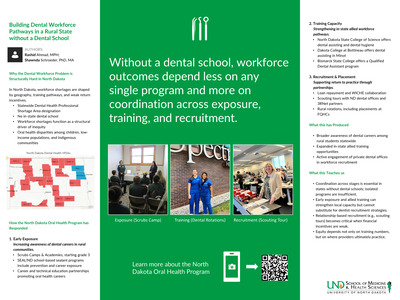
In North Dakota, workforce shortages are shaped by geography, training pathways, and weak return incentives.
- Statewide Dental Health Professional Shortage Area designation
- No in-state dental school
- Workforce shortages function as a structural driver of inequity • Oral health disparities among children, low-income populations, and Indigenous communities
Printing is not supported at the primary Gallery Thumbnail page. Please first navigate to a specific Image before printing.