

Files
Download Full Text (1.4 MB)
Description
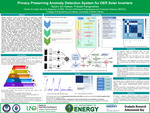
Reliable operation of solar inverters depends on maintaining a stable frequency. Recent cyber attacks on solar DERs are concerning and increase the likelihood of such stealthy attacks leading to anomalies in DER. Therefore, a robust anomaly detection system (ADS) is crucial for solar inverters used in distributed energy resources (DERs), enabling timely detection and correction of frequency anomalies. Additionally, preserving data privacy is essential for the security and reliability of the power grid. This paper proposes a privacy-preserving anomaly detection system (PP-ADS) based on a multi-stage hybrid machine learning (MSHML) model specifically designed for solar inverter data in DER environments. The MSHML model combines Random Forest and K- Nearest Neighbors regression algorithms. The proposed PP-ADS operates on edge devices installed near the inverter, eliminating the need to transmit raw data to a central server and thereby preserving data privacy. This novel approach employs regression models and a Mean Absolute Error (MAE)-based thresholding mechanism for anomaly detection. One month of real-time operational data from two Fronius Primo 15.0-1 208-240 single-phase solar inverters was used to train the model. The evaluation was performed using datasets with synthetically injected anomalies. The PP-ADS achieved a recall rate of 71.1%, demonstrating its effectiveness in identifying critical faults. The proposed PP-ADS offers a lightweight, adaptive, and edge-compatible solution, enhancing both reliability and cybersecurity in smart grids integrated with DERs.
Publication Date
3-5-2026
Document Type
Poster
City
Grand Forks, ND
Disciplines
Cybersecurity
Recommended Citation
Hassan, Tanzim Jim and Ranganathan, Prakash, "Privacy Preserving Anomaly Detection System for DER Solar Inverters" (2026). Graduate Research Achievement Day Posters. 13.
https://commons.und.edu/grad-posters/13
Comments
Presented at the 2026 UND Graduate Research Achievement Day.