

Files
Download Full Text (1.2 MB)
Description
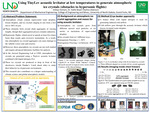
Atmospheric clouds contain supercooled water droplets, frozen droplets, and ice crystals ranging in size from a few nm to 100’s of µm. These elements form crystal chain aggregates of varying lengths, though their aggregation process remains unknown. Hypersonic flights, which travel at speeds at least five times faster than sound, gain excessive momentum. As a result, tiny atmospheric ice crystal aggregates can cause damage to the vehicle’s nose cone and exterior. However, these atmospheric ice crystals are not well studied and require advanced laboratory facilities for analysis. At the Aerosol Engineering Lab at UND, atmospheric ice crystals are generated using a TinyLev acoustic levitator combined with liquid nitrogen (N₂). These ice crystals are produced to drop in front of the shockwave (inside Purdue’s 3-inch shock tube) to study their behavior in a hypersonic environment. This research also contributes to a deeper understanding of climate science and global atmospheric models.
Publication Date
2-26-2025
Document Type
Poster
City
Grand Forks, ND
Keywords
Ice crystal, Ice, Crystal, Crystals, Aggregates, Hypersonics, Hypersonic, Acoustic, Levitator, TinyLev, Interaction, Levitation
Recommended Citation
Osmani, Imteaz and Chelmo, Hallie Boyer, "Using TinyLev acoustic levitator at low temperatures to generate atmospheric ice crystals (obstacles to hypersonic flights)" (2025). Graduate Research Achievement Day Posters. 12.
https://commons.und.edu/grad-posters/12
Comments
Presented at the 2025 UND Graduate Research Achievement Day.