


Born in 1879, Usher Burdick served in North Dakota's House of Representatives from 1909-1911, as Lieutenant Governor of North Dakota from 1911-1913, and subsequently for multiple terms in the United States House of Representatives (1935-1945, 1949-1959) before his death in 1960.
The digitization of these papers has been made possible in part by the National Endowment for the Humanities: Exploring the human endeavor. Any views, findings, conclusions, or recommendations expressed in this website, do not necessarily represent those of the National Endowment for the Humanities.
















-
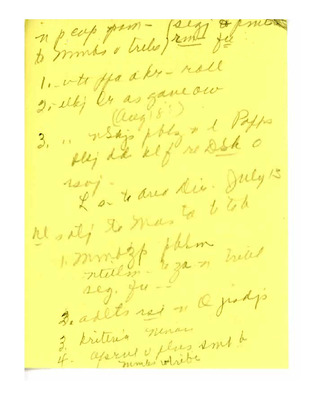
Please Help Our Own American Indians: Give Them a Chance, They Will Make Good, February 1953
George S. Stephenson
This statement dated February 1953, by George S. Stephenson, addresses the issue of food availability for Native Americans. In this statement, Stephenson comments on wheat and corn being sold at a fraction of its value or burned as fuel, while tribal members did not have enough food. Stephenson calls on the United States Congress to pass an emergency relief bill to allocate one million bushels of wheat to be distributed to "American Indians."
There is a handwritten annotation at the top of the statement.
See also:
Letter from Sam Stern to Representative Burdick Regarding George Stephenson, November 4, 1952
-
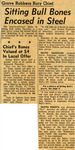
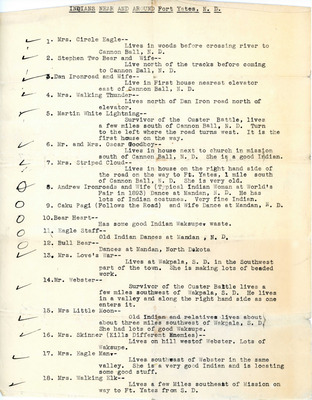
Sitting Bull’s Bones Encased in Steel, circa 1953.
Unknown
This article, published circa 1953, discusses the the final resting place of the ancestral remains of Sitting Bull (Tatanka Iyotanka), a Hunkpapa Lakota leader, who was removed from a burial site in Fort Yates, ND to Mobridge, SD. The article notes that the removal was incomplete and that individuals were able to get “4$ apiece in Bismarck” for the bones of Sitting Bull. The article also quotes of head of the removal party, which included self-proclaimed heirs of Sitting Bull who said, “I was tired of the white man’s red tape and delays.”
-
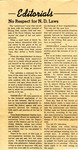
No Respect for N.D. Laws, April 4, 1953
Unknown
This editorial, dated April 19, 1953, addresses the controversy surrounding the removal of the ancestral remains of Sitting Bull (Tatanka Iyotanka), a Hunkpapa Lakota leader, from his grave at Fort Yates, North Dakota "by a small band of South Dakotans." It condemns the inaction of the Standing Rock Reservation Superintendent, Charles Spencer, who did not prevent the removal and failed to uphold the ND state law that protects burial sites. The editorial calls for accountability against those officials who violate their responsibilities.
-
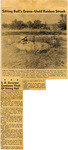
Sitting Bull’s Grave-Until Raiders Struck, circa 1953
Unknown
This article, published in circa 1953, subtitled "S.D. Governor Condones Theft of Sitting Bull," reports on the reaction of South Dakota Governor Sigurd Anderson regarding the removal of the ancestral remains of Sitting Bull (Tatanka Iyotanka), a Hunkpapa Lakota leader, from their previous resting place in Fort Yates, ND to a new location in Mobridge, SD. Anderson said that he is not in favor of the law breakers, but he can understand their sentiment.
-
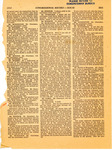
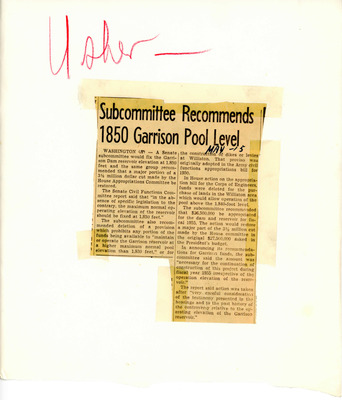
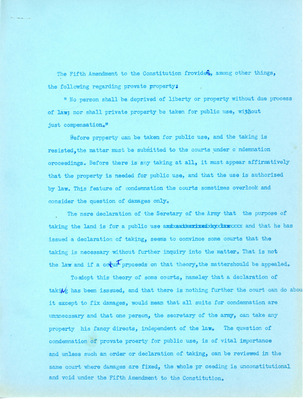
Excerpt from Congressional Record Regarding Amendment Proposed by Representative Burdick to Reduce Appropriation to Corps of Army Engineers, May 27, 1953
US Congress and Usher Burdick
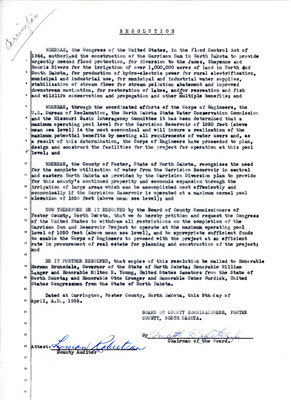
This excerpt from the United States (US) Congressional record, dated May 2, 1953, contains debate over an appropriations bill to which US Representative Usher L. Burdick offers an amendment to reduce the appropriation to the US Corps of Army Engineers for continued construction on the Garrison Dam and Reservoir.
Included in the debate over Burdick's amendment are representatives Gordon L. McDonough, Hubert Scudder and Craig Hosmer of California, Glen Davis of Wisconsin, Donald W. Nicholson of Massachusetts, John Taber of New York, and Otto G. Krueger of North Dakota, who spoke out against Burdick's amendment.
Burdick's rationale in reducing the appropriation for the Corps of Army Engineers was that they were, without authorization from the US Congress, increasing the surface area and raising the pool level of the reservoir, endangering the city of Williston and nearby irrigation facilities along the Missouri River, and were seizing land to accommodate these increases of area and pool height, and that reducing their appropriation would limit these activities.
See also:
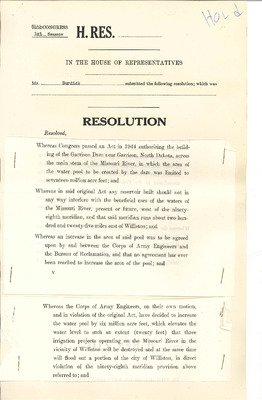
Drafts of Resolution by Representative Burdick Regarding Pool Level of Garrison Dam Reservoir, Undated
-
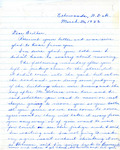
Letter from Lillie Wolf to James Black Dog Regarding Garrison Dam, March 26, 1953
Lillie E. Wolf
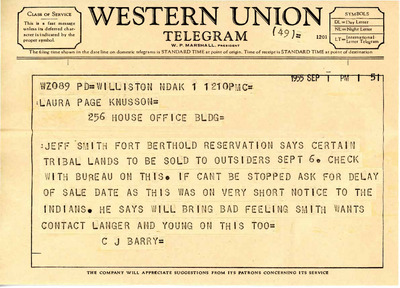
This letter, dated March 26, 1953, from Lillie E. Wolf of Elbowoods on the Fort Berthold Reservation of North Dakota to her brother James Black Dog conveys Wolf's recent experiences regarding her refusal to sell her land, which is scheduled to be inundated by the reservoir behind the Garrison Dam, along with rumors and speculation about possible payouts from the Fort Berthold Indian Agency. The letter is handwritten.
-
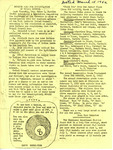
Article: "Burdick Asks for Investigation of Tribal Council," March 15, 1952
author unknown
This article dated March 15, 1952, author unknown, notifies readers that United States (US) Representative Usher Burdick has introduced a resolution to investigate the Fort Berthold Tribal council due to complaints from some members over the handling of tribal funds. It is noted that although the Tribal Council denies the claims, they welcome the investigation. The article is in what appears to be a tribal newsletter, but the document is incomplete. The document contains other articles and a map of the proposed Western Segment Subagency of the Fort Berthold Reservation.
See also:
Letter from Marjorie Slocum to Representative Burdick Regarding Unfair Treatment by the Three Affiliated Tribes Tribal Council, March 27, 1952
-
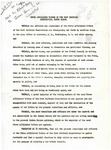
Resolution Passed by Three Affiliated Tribes Calling for the Ousting of Current Tribal Council and Immediate Special Election to Appoint New Council Sent from Black Dog to Oscar Burr for Circulation, February 8, 1952
author unknown
This undated and unsigned resolution calls for the resignation of the present Three Affiliated Tribes Business Council members and officers and for a special election to be held as soon as possible to elect a new council. The resolution levels several accusations against the current tribal council, including Chairperson Martin Cross, and claims that the majority of voting members of the tribes are dissatisfied with the conduct of the current tribal council members. The resolution has "Three Affiliated Tribes of the Fort Berthold Reservation, North Dakota" as a header. A handwritten note at the top of the resolution has the date February 8, 1952 and a note that says, "50 copies sent by Black Dog to Oscar Burr--to be circulated."
See also:
Letter from Dale E. Doty Regarding Response from Members of the Three Affiliated Tribes to Burdick's Letter Attempting to Resolve Current Tribal Conflict, January 24, 1952
-
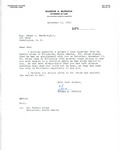
Letter from Eugene Burdick to Representative Burdick Regarding Letter from Martin Cross and a Missed Appointment, December 15, 1952
Eugene Burdick
This letter, dated December 15, 1952, from Eugene Burdick to his father United States (US) Representative Usher Burdick makes reference to an enclosed letter that Eugene received from Martin Cross regarding a missed appointment with Usher. Cross wanted to meet with Usher to discuss a petition that Cross then mailed to Usher. Eugene advises Usher to follow up with Cross. The letter from Cross referred to as being enclosed was not found with this document in Usher Burdick's papers.
See also:
Letter from Martin Cross to Representative Burdick Enclosing Petition Calling for the Investigation of Jefferson B. Smith, December 13, 1952
Letter from Representative Burdick to Martin Cross Regarding a Missed Appointment, December 19, 1952
-
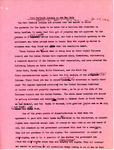
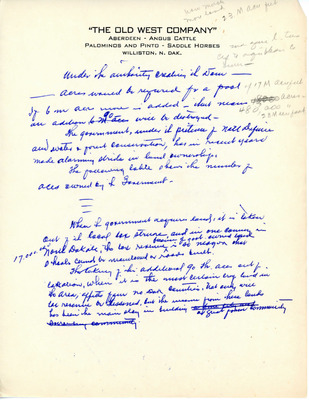
Draft of Statement: "Fort Berthold Indians on the War Path," by Representative Burdick, January 25, 1952
Usher Burdick
This statement draft dated January 25, 1952, by United States House Representative Usher Burdick, addresses dissent among tribal members at the Fort Berthold Reservation about how the payments for the lands taken for the construction of Garrison Dam are being handled. Burdick notes that the plan was not voted on in a regular election and that many of the people who initially supported the resolution withdrew their support once they understood what it actually entailed. Burdick writes that a majority of tribal members have organized under their own leaders in opposition to the Tribal Business Council. Burdick cites the failure to retain mineral rights as one of the primary points of contention by those who object to the payment resolution. The objectors set up their own legal counsel, as regular counsel for Fort Berthold is working in support of the Tribal Business Council. In closing, Burdick acknowledges that the opposition has not received much support in Washington D.C. or from the United States Bureau of Indian Affairs and that the legal action they are taking is in the interest of protecting the rights of the majority of tribal members.
There are many handwritten annotations and corrections on this draft.
-
Letter from Representative Burdick to Emma Jones Regarding Per Capita Payments, January 31, 1952
Usher Burdick
This letter dated January 31, 1952 from United States (US) Representative Usher Burdick to Emma L. Jones thanks Jones for her January 28 letter regarding per capita payments. Burdick informs Jones that he is in favor of per capita payments and that he will do what he can to help the tribes get a "square deal."
-
Letter from Representative Burdick to Hal Davies Regarding History of the Garrison Dam, January 14, 1952
Usher Burdick
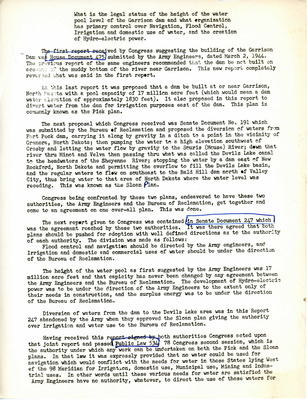
This letter dated January 14, 1952, from United States (US) Representative Usher Burdick to Hal Davies of Minot, North Dakota, recounts a condensed history of the building of Garrison Dam. Topics Burdick addresses include: pool level, flood control, water navigation, power development, and irrigation. Burdick makes it clear he thinks all desired outcomes from the dam can be achieved at the lower pool level of the Garrison Reservoir.
Burdick also mentions enclosing a copy of a brief he presented to a committee in the US Congress. The brief was not found with this letter in the Burdick papers.
-
Letter from Representative Burdick to H. F. Gierke, Jr. Informing of an April 4 Hearing That Will Address Complaints Made by Members of the Three Affiliated Tribes and Others Including Those Made by Gierke, March 24, 1952
Usher Burdick
This letter, dated March 24, 1952, from United States (US) Representative Usher Burdick to H. F. Gierke Jr. of Watford City, North Dakota informing Gierke of a hearing on April 4 before the sub-committee on Interior and Insular Affairs to deal with some complaints, including those made by Gierke.
See also:
Letter from H. F. Gierke, Jr. to Representative Burdick Regarding Money Paid to the Three Affiliated Tribes and the Relocation of the Agency, March 15, 1952
Letter from H.F. Gierke, Jr. to Representative Burdick Regarding Questions He Wishes to See Addressed at April 4 Hearing, March 28, 1952
-
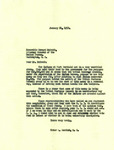
Letter from Representative Burdick to Howard McGrath Regarding Tribal Business Council, January 21, 1952
Usher Burdick
This letter, dated January 21, 1952, from United States (US) Representative Usher Burdick to US Attorney General Howard McGrath concerns the Tribal Business Council of the Three Affiliated Tribe of the Fort Berthold Reservation. Burdick writes that Fort Berthold tribal members are unsettled due to events related to the sale of lands for the Garrison Dam, explaining that the Tribal Business Council, under the supervision of the Indian Bureau, proposes to allot each member $1000 and then use the remainder of the money from the sale as they see fit for communal benefit.
There is a rumor, he writes, that the Tribal Business Council is using some of the funds in unauthorized ways, which has turned 80% of the members against the actions of the Tribal Business Council, and some members are calling for the US Federal Bureau of Investigation (FBI) to investigate the Tribal Business Council. Burdick writes that he believes that, unless the Council is charged with some crime, the FBI will not act, and asks McGrath, in the event that Burdick is wrong about this and an investigation is indeed possible, to do so and determine whether the tribes' funds are intact or are being unlawfully dissipated.
See also: Letter from Representative Burdick to Oscar Berg et al. Regarding Three Affiliated Tribes Tribal Business Council, January 14, 1952
-
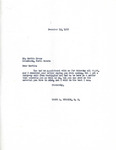
Letter from Representative Burdick to Martin Cross Regarding a Missed Appointment, December 19, 1952
Usher Burdick
This letter, dated December 19, 1952, from United States (US) Representative Usher Burdick to Three Affiliated Tribes Tribal Chairperson Martin Cross acknowledges that Burdick and Cross had an appointment, but explains that Burdick was pulled away to Washington, D.C. to tend to a matter that concerned both himself and Cross, and that is the reason he missed their meeting. Burdick asks Cross to send the pertinent materials and Burdick will do what he can.
See also:
Letter from Eugene Burdick to Representative Burdick Regarding Letter from Martin Cross and a Missed Appointment, December 15, 1952
Letter from Martin Cross to Representative Burdick Regarding the Petition Calling for the Investigation of Jefferson B. Smith, December 31, 1952
-
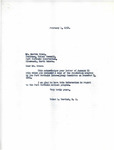
Letter from Representative Burdick to Martin Cross Thanking Cross for Forwarding Resolution Adopted on December 7 by the Fort Berthold Inter-Agency Committee, February 4, 1952
Usher Burdick
This letter, dated February 4, 1952 from United States (US) Representative Usher Burdick to Three Affiliated Tribes Tribal Chairperson Martin Cross acknowledges Cross's January 29 letter which enclosed the December 7 resolution passed by the Fort Berthold Inter-Agency committee. Burdick thanks him for this information.
See also:
Letter from Martin Cross to Representative Burdick Forwarding a Resolution from the Fort Berthold Inter-Agency Committee Adopted on December 7, January 29, 1952
Congressional Record (Senate), February 7, 1952 Vol. 98, Part 1--Bound Edition
-
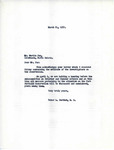
Letter from Representative Burdick to Martin Fox Informing of a Hearing on April 4 Regarding the Conflict Within the Three Affiliated Tribes, March 24, 1952
Usher Burdick
This letter, dated March 24, 1952, from United States (US) Senator Usher Burdick to Three Affiliated Tribes member Martin Fox informs Fox of a hearing before the sub-committee on Interior and Insular Affairs on April 4 to address concerns regarding the Three Affiliated Tribes of the Fort Berthold Reservation.
See also:
Letter from Martin Fox to Representative Burdick Expressing Concern that the Three Affiliated Tribes Tribal Council has not been Transparent with Tribal Members, Likely 1952
-
Letter from Representative Burdick to Martin Fox Regarding Attitude of Investigators on Fort Berthold Reservation, March 24, 1952
Usher Burdick
This letter, dated March 24, 1952, from United States (US) Representative Usher Burdick to Martin Fox acknowledges receipt of Fox's letter regarding the attitude of investigators on the Reservation. Burdick also informs Fox that there will be a hearing on April 4 before the sub-committee on Interior and Insular Affairs.
-

Letter from Representative Burdick to Mr. A. E. Keller Regarding Per Capita Payments, March 31, 1952
Usher Burdick
This letter, dated March 31, 1952, from United States (US) Representative Usher Burdick to A. E. Keller of Stanton, North Dakota refers to Keller's recent letter regarding per capita payments to the two indigenous girls he has adopted. Burdick informs Keller that this matter and others will be discussed at hearings that start on April 4.
See also:
Letter from Laura Page Knudson for Representative Burdick to A. E. Keller Regarding Per Capita Payments, June 5 1922
-
Letter from Representative Burdick to Mrs. S. L. Krag Regarding Garrison Dam, February 13, 1952
Usher Burdick
This letter, dated February 13, 1952, from United States (US) Representative Usher Burdick to Mrs. S. L. Krag of Minot, North Dakota is a reply to Mrs. Krag's letter of January 28 concerning the effects of the Garrison Dam on the Three Affiliated Tribes of the Fort Berthold Reservation.
Burdick writes that he called the Indian Bureau immediately after receiving her letter and asked for the information she requested, including booklets and pamphlets, and was told they would be sent promptly. After not receiving them, Burdick contacted the department again and was told that the department handling such requests was being taken over by a new chief, which had resulted in many delays.
He writes in closing that he hopes Krag receives the relevant documents in time to prepare her paper for her club on February 28.
-
Letter from Representative Burdick to Oscar Berg et al. Regarding Three Affiliated Tribes Tribal Business Council, January 14, 1952
Usher Burdick
This letter, dated January 14, 1952, from United States (US) Representative Usher Burdick to Oscar Berg, Percy Rush, Rufus Stevenson, and Jim Blackdog (also known as James Black Dog) of Elbowoods, North Dakota on the Fort Berthold Reservation, concerns the Tribal Business Council of the Three Affiliated Tribes of the Fort Berthold Reservation. Burdick writes that if the recipients feel the Tribal Council is violating its constitution or bylaws, they could file a petition with the Secretary of the Interior. Burdick adds that they have a right to choose an attorney separate from the Tribal Council attorney, and that he believes the US Secretary of the Interior would provide reasonable compensation for such an attorney.
See also:
Letter from Representative Burdick to Oscar L. Chapman Regarding Tribal Council, January 14, 1952
-
Letter from Representative Burdick to Oscar L. Chapman Enclosing a Letter to Members of the Three Affiliated Tribes Which Burdick Hopes Will Help Resolve Current Tribal Conflict, January 14, 1952
Usher Burdick
This letter, dated January 14, 1952, from United States (US) Representative Usher Burdick to US Secretary of the Interior Oscar Chapman encloses a letter that Burdick drafted to the "discontented" tribal members on the Fort Berthold Reservation. Burdick is looking for a way to solve the "continual turmoil" on the reservation. The letter Burdick has enclosed is addressed to Oscar Berg, Percy Rush, Rufus Stevenson, and Jim Blackdog (also known as James Black Dog). The letter states that if the recipients feel that the Tribal Council has violated their constitution and by-laws, then they should petition the Secretary of the Interior to hold a hearing.
See also:
Letter from Dale E. Doty Regarding Response from Members of the Three Affiliated Tribes to Burdick's Letter Attempting to Resolve Current Tribal Conflict, January 24, 1952
-
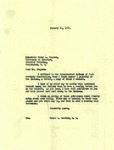
Letter from Representative Burdick to Oscar L. Chapman Regarding Three Affiliated Tribes Tribal Council, January 14, 1952
Usher Burdick
This letter, dated January 14, 1952, from United States (US) Representative Usher Burdick to Oscar L. Chapman concerns the Tribal Business Council of the Three Affiliated Tribes of the Fort Berthold Reservation. Burdick writes that he has responded to a group of discontented tribal members and believes a hearing to air grievances will help settle the turmoil.
See also: Letter from Representative Burdick to Oscar Berg et al. Regarding Three Affiliated Tribes Tribal Business Council, January 14, 1952
-
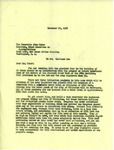
Letter from Representative Burdick to Representative John Taber Regarding Appropriations for Garrison Dam, December 22, 1952
Usher Burdick
This letter dated December 22, 1952, from United States (US) Representative Usher Burdick to US Representative John Taber, expresses Burdick's objections to spending by the US Army Corps of Engineers in order to built the Garrison Dam to a higher pool level than originally authorized. Burdick details the unauthorized measures and resulting expenditures being made in order to built to the higher the pool level, and argues that the US Army Corps of Engineers be held responsible for the excess money that they spent on the Garrison Dam project. Burdick asks Taber, as chair of the House Committee on Appropriations, to make inquiries into the Corp of Engineers' spending and actions before appropriating further funds for the project.
-
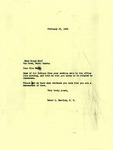
Letter from Representative Burdick to Rose Drags Wolf Regarding Her Possible Relation to Sakakawea, February 25, 1952
Usher Burdick
This letter, dated February 25, 1952, from United States (US) Representative Usher Burdick to Rose Drags Wolf refers to a visit by member of the Three Affiliate Tribes of Fort Berthold who mentioned to Burdick that Drags Wolf claims to be related to Sakakawea. In this letter, Burdick asks Drags Wolf to inform Burdick of any evidence related to this claim.